
Explanation: This means that 1 mole of potassium will have a mass of 39 grams.
Chemical properties of potassium - Health effects of potassium - Environmental effects of potassium
- Multiply these numbers by the atomic mass to get each element's mass contribution. Mass contribution of K = 3 x 39.10 = 117.30 g/mol Mass contribution of Fe = 1 x 55.85 = 55.85 g/mol.
- Watch more videos on FOR All OUR VIDEOS!https://www.youtube.com/subscriptioncenter?adduser=brightstor.
- ››More information on molar mass and molecular weight. In chemistry, the formula weight is a quantity computed by multiplying the atomic weight (in atomic mass units) of each element in a chemical formula by the number of atoms of that element present in the formula, then adding all of these products together.
|
Potassium The name is derived from the english word potash. The chemical symbol K comes from kalium, the Mediaeval Latin for potash, which may have derived from the arabic word qali, meaning alkali. The chemistry of potassium is almost etirely that of the potassium ion, K+. Applications Most potassium (95 %) goes into fertilizers and the rest goes mainly into making potassium hydroxide (KOH), by the electrolysis of potassium chloride solution, and then converting this to potassium carbonate (K2CO3). Potassium carbonate goes into glass manufacture, expecially the glass used to make televisions, while potassium hydroxide is used to make liquid soaps and detergents. A little potassium chloride goes into pharmaceuticals, medical drips and saline injections. Potassium in the environment Most potassium occurs in the Earth's crust as minerals, such as feldspars and clays. Potassium is leached from these by weathering, which explains why there is quite a lot of this element in the sea (0.75 g/liter). Health effects of potassium
Environmental effects of potassiumTogether with nitrogen and phosphorous, potassium is one of the essential macrominerals for plant survival. Its presence is of great importance for soil health, plant growth and animal nutrition. Its primary function in the plant is its role in the maintenance of osmotic pressure and cell size, thereby influencing photosynthesis and energy production as well as stomatal opening and carbon dioxide supply, plant turgor and translocation of nutrients. As such, the element is required in relatively large proportions by the growing plant. The consequences of low potassium levels are apparent in a variety of symptoms: restricted growth, reduced flowering, lower yields and lower quality produce. Check out our potassium in water page Back to the periodic table of elements |
Atomic Mass Of Kc
More from 'Elements' Softube plugins crack mack.
Lenntech (European Head Office)
Distributieweg 3
2645 EG Delfgauw
The Netherlands
Phone: +31 152 610 900
fax: +31 152 616 289
e-mail: info@lenntech.com
K Atomic Number
Lenntech USA LLC (Americas)
5975 Sunset Drive
South Miami, FL 33143
USA
Phone: +1 877 453 8095
e-mail: info@lenntech.com
Lenntech DMCC (Middle East)
Level 5 - OFFICE #8-One JLT Tower
Jumeirah Lake Towers
Dubai - U.A.E.
Phone: +971 4 429 5853
e-mail: info@lenntech.com
Copyright © 1998-2021 Lenntech B.V. All rights reserved
Atomic Mass
Atomic mass is based on a relative scale and the mass of 12C (carbon twelve) is defined as 12 amu.
Why do we specify 12C? We do not simply state the the mass of a C atom is 12 amu because elements exist as a variety of isotopes.
Carbon exists as two major isotopes, 12C, and 13C (14C exists and has a half life of 5730 y, 10C and 11C also exist; their half lives are 19.45 min and 20.3 days respectively). Each carbon atom has the same number of protons and electrons, 6. 12C has 6 neutrons, 13C has 7 neutrons, and 14C has 8 neutrons and so on. Since there are a variety of carbon isotopes we must specify which C atom defines the scale.
All the masses of the elements are determined relative to 12C.
By the way, the mass of an element is not equal to the sum of the masses of the subatomic particles of which the element is made!
Average Atomic Mass
Since many elements have a number of isotopes, and since chemists rarely work with one atom at a time, chemists use average atomic mass.
On the periodic table the mass of carbon is reported as 12.01 amu. This is the average atomic mass of carbon. No single carbon atom has a mass of 12.01 amu, but in a handful of C atoms the average mass of the carbon atoms is 12.01 amu.
Why 12.01 amu? Professional peugeot citroen diagnostic software free download.
If a sample of carbon was placed in amass spectrometer the spectrometer would detect two different C atoms, 12C and 13C.
The natural abundances of 14C, 10C and 11C are so low that most mass spectrometers cannot detect the effect these isotopes have on the average mass. 14C dating is accomplished by measuring the radioactivity of a sample, not by actually counting the number of 14C atoms.
The average mass of a carbon is calculated from the information the mass spectrometer collects.
The mass spectrometer reports that there are two isotopes of carbon,
98.99% of the sample has a mass of 12 amu (not a surprise since this is the atom on which the scale is based).1.11% of the sample has a mass of 13.003355 amu (this isotope is 1.0836129 times as massive as 12C)
The average mass is simply a weighted average.
ave. mass = 12.01 amu
Atomic Mass Of K2
(Yes, the number 12.01 has the right number of significant figures, even though 1.11% only has 3 significant figures.)
If we know the natural abundance (the natural abundance of an isotope of an element is the percent of that isotope as it occurs in a sample on earth) of all the isotopes and the mass of all the isotopes we can find the average atomic mass. The average atomic mass is simply a weighted average of the masses of all the isotopes.
(Yes, the sig figs are correct.)
Another kind of question could be asked..
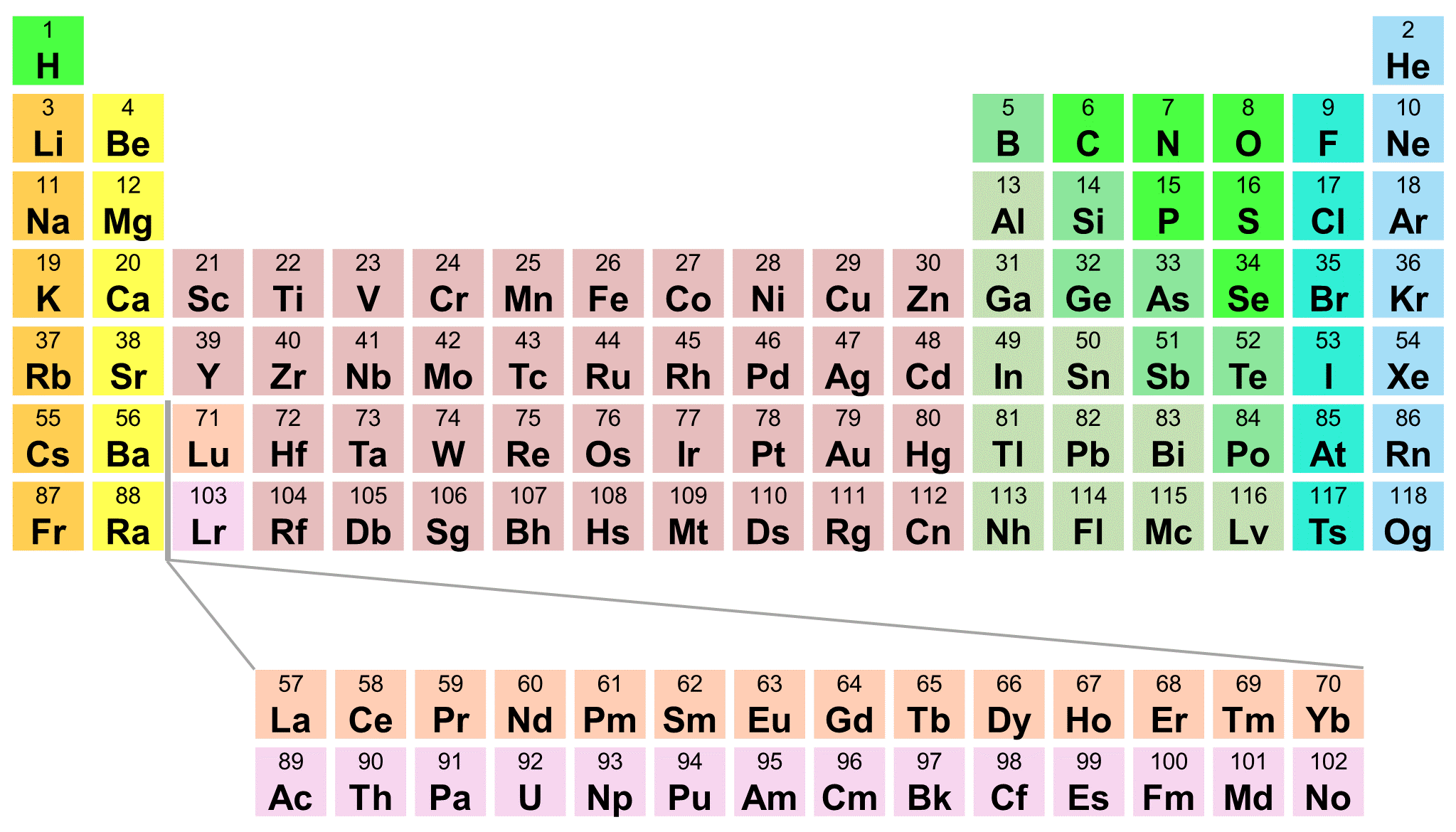
Copper has two isotopes 63Cu and 65Cu. The atomic mass of copper is 63.54. The atomic masses of 63Cu and 65Cu are 62.9296 and 64.9278 amu respectively; what is the natural abundance of each isotope?
substituting gives
One equation and two unknowns..is there another equation? If there is another equation we would have two equations and two unknowns, and a system of two equations and two unknowns is solvable.
Since there are only two major isotopes of Cu we know that
or
Atomic Mass Of Kclo3
(eq. B)
Use eq. B to substitute for %63Cu in eq. A.
To the correct number of significant figures
Of course, a question like the one above could be turned around another way.
Gallium, atomic mass 69.72 amu, has two major isotopes, 69Ga, atomic mass 68.9257 amu, and 71Ga. If the natural abundance of each isotope is 60.00 and 40.00 % respectively what is the mass (in amu) of 71Ga.
The mole
What is the relative mass of 1 C atom as compared to 1 H atom?
What is the relative mass of 100 C atoms as compared to 100 H atoms?
What is the relative mass of 1 W atom as compared to 1 H atom?
What is the relative mass of 100 W atoms as compared to 100 H atoms?
The point here? As long as the number of atoms remains the same the relative mass does not change.
Atoms are small, and it is possible to place 1.0079 g of H on a balance (possible but not easy in the case of hydrogen).
It is also possible to place 183.9 g W, or 12.01 g of C on a balance.
Now, I state with absolute certainty that I have placed the same number of atoms on each balance! How do I know? I know because the relative masses of the samples on the balance, are the same as the relative masses of the individual atoms.
W:H = (183.9 g/1.0079 g):1 = 182:1C:H = (12.01 g/1.0079 g):1 = 11.92:1
The number of atoms I placed on the balance is know as a mole.
For many years the number of atoms in a mole remained unknown; however, now it is know that a mole of atoms contains 6.02214 x 10²³ atoms.

So, the periodic table provides us with a great deal of information.
The periodic table lists
the mass of an atom in amu,the mass of a mole of atoms (i.e. the molar mass) in grams,
and the mass of 6.02214 x 10²³ atoms in grams
The atomic mass of C is 12.01 amu. What is the mass of 1 C atom?